
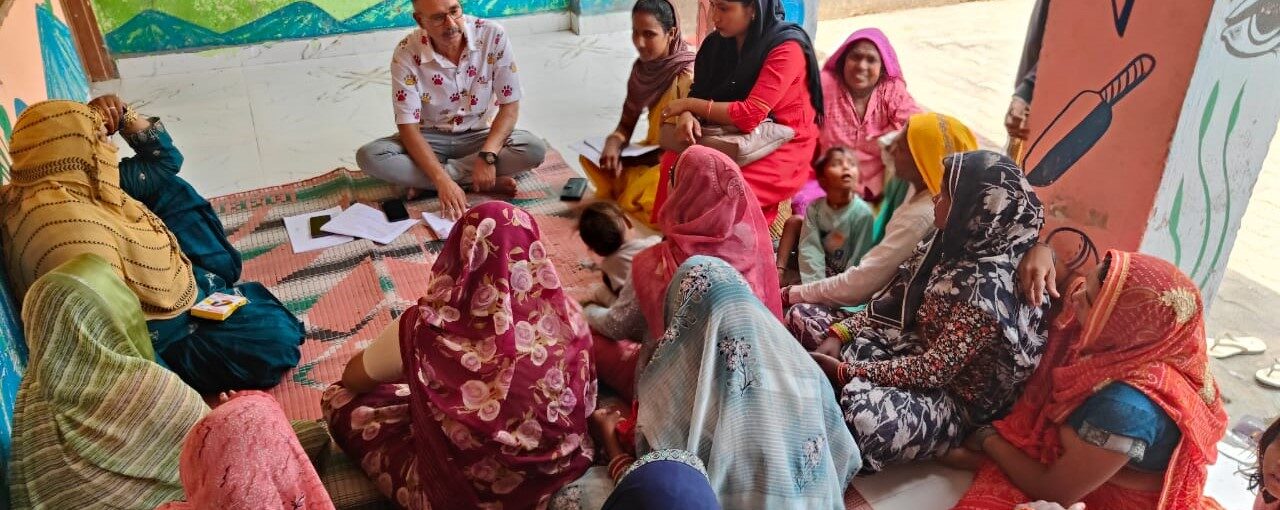
By ETASHA Society | Women's Economic Empowerment | Nuh District, Haryana
Rural women in India are often told that financial inclusion is the answer to poverty. Open a bank account. Get a microloan. Start a business. But anyone who has worked at the grassroots level knows that money alone doesn’t move the needle; not when a woman cannot step outside her home without permission, has never been told her idea has value, and has no one around her who has done it before.
This is the gap that ETASHA Society has been working to close for over two decades. And it is the gap that our new project, Kamyaabi, is designed to address at its roots.
The Evidence Base: Why Nuh, and Why Now
Nuh district consistently ranks among the most socioeconomically disadvantaged districts in Haryana. Literacy levels in the project area remain below 40%. Per capita income is significantly below the state average. Female workforce participation is low, and infrastructure for health, sanitation, and digital connectivity remains inadequate.
These are not arguments for charity. They are arguments for investment in skills, in market linkages, and in the confidence of women.
It is not ambition. Women in these villages have plenty of ideas and dreams. What they lack is the ecosystem to act on them.
Low financial literacy means women do not know how to price a product, read a basic account book, or understand the difference between revenue and profit. Without this, even a successful-seeming business slowly bleeds money.
No digital access or skills increasingly means exclusion from markets, government schemes, and information. In a post-pandemic world, a business that cannot use a smartphone is a business left behind.
Restricted mobility and decision-making power mean that even a woman with a great idea may need family approval to attend a training, open a bank account, or visit a market two villages away.
Isolation is perhaps the most underrated barrier. When you are the only woman in your village trying to run a small enterprise, every setback feels like proof that it cannot be done.
ETASHA has already seen what is possible here. Our Grassroots Entrepreneurship Program has been successful in establishing 262 enterprises owned by young men and women in the same district and the results made one thing clear: the demand, the potential, and the will to change are very much present. Kamyaabi is the next step in that journey, now with women at the centre.
Introducing Project Kamyaabi:
ETASHA's Initiative in Nuh
ETASHA Society is launching Project Kamyaabi, a 12-month intensive program targeting 180 women aged 18-50 across 21 villages in Ferozepur Jhirka and Nagina blocks of Nuh district, Haryana.
The goal is to establish 150 women-led micro-enterprises while simultaneously building a community ecosystem that sustains them.
What Kamyaabi Delivers
- Entrepreneurship, financial, and digital literacy training delivered in batches of women, with hands-on, practical exposure
- Business plan development and mentorship with dedicated field officers making enterprise visits
- Community launch events to publicly celebrate women entrepreneurs and shift local attitudes toward women’s economic participation
- Peer learning platforms structured support circles at the village and cluster level
- Sahayikas high-performing entrepreneurs who receive leadership training and mentor their peers, creating a self-sustaining mentoring infrastructure
- Social empowerment sessions covering gender rights, safety, and access to government entitlements
- Stakeholder linkages connecting women to government schemes including PMEGP, MUDRA Yojana, and Haryana Gramin Udyogik Vikas Yojna
Kamyaabi is implemented with a ground collaboration partner and is supported by a CSR funding partner, ensuring that economic and social change move together.
The Social Empowerment Layer: Why It Cannot Be Separated from Economics
A woman who has completed entrepreneurship training but does not know her rights under the Protection of Women from Domestic Violence Act, or does not know she is entitled to a ration card, a bank account in her own name, or free health services- that woman is still vulnerable.
This is why ETASHA integrates social empowerment into its livelihood work. Monthly sessions on gender, personal safety, legal entitlements, health, and self-advocacy are not supplementary; they are foundational. An entrepreneur who understands her rights negotiates better with suppliers, with family, and with government officials.
What Success Looks Like Beyond the Numbers
ETASHA measures program impact through business establishment rates, revenue growth, and knowledge assessments. But the real measure of Kamyaabi’s success will be less quantifiable: a woman in Agon village who no longer needs to ask permission to go to the market. A peer group in Ghaghas that collectively negotiates better prices for raw materials. A Sahayika in Moolthan who teaches ten other women what she learned and does it because she wants to.
That is what economic empowerment looks like when it is built to last.
ETASHA Society has been working on education, employment, and entrepreneurship in underserved communities since 2006. To learn more about Project Kamyaabi or explore partnership and volunteering opportunities, write to us at parul@etashasociety.org